This article was written specifically for the DC Soccer Club community by Dr. Samuel Kinney, one of Cohen Health and Performance’s Doctors of Physical Therapy and a former collegiate soccer player who understands the demands of the game.
DC Soccer Club is proud to partner with Cohen Health and Performance (CHP) as our official physical therapy and performance training partner. CHP (cohenhp.com) has locations in Bethesda and McLean, working with youth and high school athletes to help them stay healthy, recover from injuries, and perform at their best through individualized sports physical therapy, injury-prevention education, and performance training.
As part of this partnership, CHP shares practical guidance and expert insights to help DCSC players and families better understand how to support long-term athletic development, reduce injury risk, and navigate common challenges throughout the season.
This article was written specifically for the DC Soccer Club community by Dr. Samuel Kinney, one of Cohen Health and Performance’s Doctors of Physical Therapy and a former collegiate soccer player who understands the demands of the game.
_____
As a former soccer player, I remember the excitement of arriving at the field for practice or a game, putting on cleats, jogging, playing some Rondo, and finishing with a few dynamic stretches. Honestly, that’s a solid warm-up. And if a player is also strength training regularly outside of soccer, it’s usually enough.
The challenge is that many youth soccer players are busy. Between school, multiple teams, and other activities, finding time for two or three extra days of strength training each week can feel unrealistic. As a result, strength work often gets skipped altogether.
A practical solution is to build a small amount of strength training directly into the warm-up. Adding just 10 extra minutes before practice or games doesn’t replace full strength training, but it makes injury prevention far more achievable and more importantly, consistent.
COMMON SOCCER INJURIES AND HOW TO REDUCE RISK
Three of the most common injuries in youth soccer are groin strains, hamstring strains, and ACL tears. Below is a simple three-exercise series that targets the muscles involved and can be added directly into a warm-up.
1) Groin Injuries
The groin muscles connect the thigh to the pelvis and are heavily involved in side-to-side movements and stabilizing the plant leg when kicking. Groin injuries often occur during cutting or sudden changes of direction.
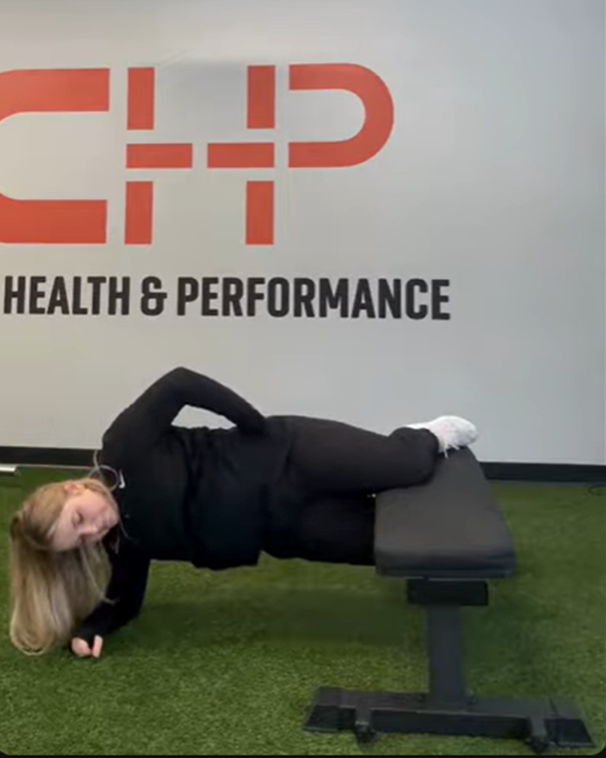
Exercise: Copenhagen Plank
This exercise strengthens the groin muscles and their attachment points.
- Can be done using a bench or bleacher with padding under the knee
- Or with a teammate supporting the leg
Perform 2 sets of 15–30 seconds.
Start with the short lever version. Once you can confidently complete 2 sets of 30 seconds, progress to long lever and go back down to 15 seconds at a time
Short Lever Video:
https://www.youtube.com/shorts/SF5Qm31c5pM
Long Lever Video: https://www.youtube.com/shorts/SzTqVY2KwN8
2) *ACL Injury Risk Reduction*
The ACL is a ligament that stabilizes the knee. An ACL tear often requires surgery and 9–12 months of rehabilitation, making risk reduction extremely important.
Strengthening the muscles around the knee, especially the quadriceps, helps improve knee stability during cutting and landing.
Exercise:
Split Squat Isometric Hold
- Hold the bottom position of a split squat
- Perform 2 sets of 20–30 seconds per side
Video: https://www.youtube.com/shorts/ULzqel_D9n8
3) Hamstring Injuries
Hamstring strains commonly occur during sprinting. Strengthening the hamstrings helps prevent these strains and supports knee stability, which can also reduce ACL injury risk.
Exercise: Hamstring Bridge on Bench or Bleacher
- Start with both feet on the bench
- Perform 2 sets of 20–30 seconds
- Progress to single-leg when ready
Video:
Double-leg elevated hamstring bridge
Video: Single-leg elevated hamstring bridge
Takeaways for Parents and Athletes
A consistent warm-up that includes a small amount of strength work can significantly reduce injury risk. These simple exercises help protect the muscles and joints most stressed in soccer, requiring extra practice time or additional training days.
Helping young athletes stay healthy means more time on the field, fewer missed seasons, and a better long-term relationship with the sport.
If you or your athlete is dealing with a soccer-related injury or wants to stay healthy, strong, and on the field this season, our team is here to help. At Cohen Health and Performance, we work with soccer players of all ages to address injuries, improve performance, and reduce future injury risk with individualized, sport-specific care.
Schedule an evaluation with a member of our team specializing in soccer athletes to get a clear, tailored plan for your goals.
Learn more or book your appointment today:
Website: www.cohenhp.com
Bethesda: (240) 686-5609
McLean: (703) 712-8277